
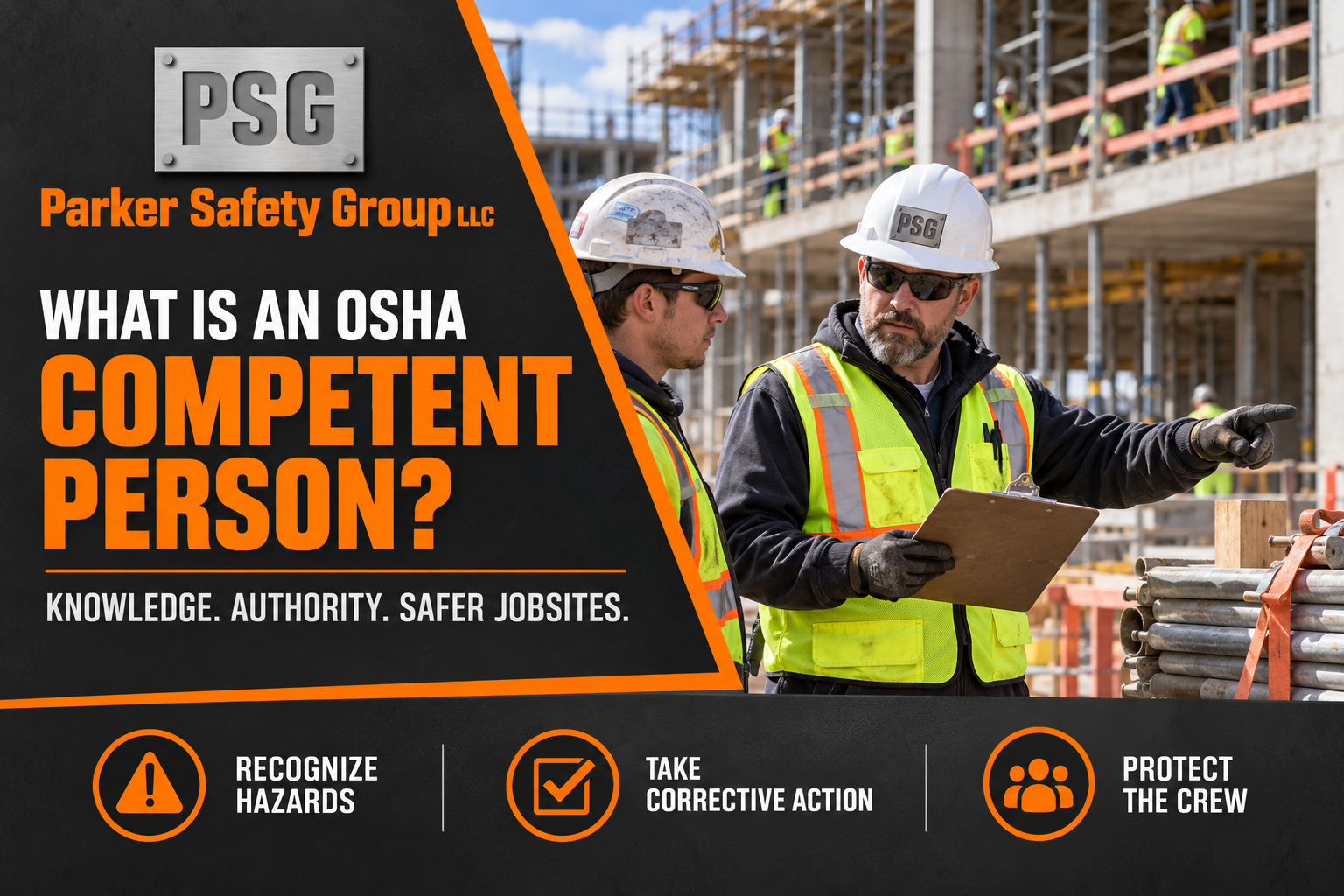
 Construction companies encounter the phrase “competent person” throughout OSHA’s construction standards. However, many contractors are uncertain about what the designation actually means, who can fill the role, and when a competent person must be present on a jobsite.
Some employers assume that their most experienced supervisor automatically qualifies. Others believe that completing a single training course is all that is required. In reality, OSHA’s definition involves more than experience or a certificate.
A competent person must understand the hazards associated with the work and have the authority to correct those hazards promptly. For construction companies, selecting the right people for this responsibility is an important part of protecting workers, maintaining compliance, and preventing avoidable jobsite incidents.
How Does OSHA Define a Competent Person?
Under OSHA’s construction standards, a competent person is someone who can identify existing and predictable hazards in the surroundings or working conditions that are unsanitary, hazardous, or dangerous to employees.
Just as importantly, that individual must also have the authorization to take prompt corrective measures to eliminate those hazards.
That definition contains two essential qualifications:
- The person must be capable of recognizing existing and foreseeable hazards.
- The person must have the authority to correct those hazards promptly.
Knowledge without authority is not enough. A worker or supervisor may recognize an unsafe condition, but if that individual cannot stop the work, remove equipment from service, change the work process, or require corrective action, the person may not satisfy OSHA’s definition.
Likewise, simply giving someone authority does not make that person competent. The individual must possess the knowledge and experience needed to recognize the hazards involved in the particular work being performed.
Is There a Universal OSHA Competent Person Certification?
There is no single, universal OSHA certification that makes an employee a competent person for every construction activity.
Training can be an important part of preparing someone for the role, but attending a course does not automatically make that individual competent for all hazards and operations. The employer is generally responsible for determining whether the selected person has the knowledge, experience, training, and authority required for the applicable work.
Competency is also specific to the hazard or activity. For example, someone who is competent to inspect scaffolding may not necessarily be competent to evaluate an excavation, develop a fall-protection system, or oversee a silica-exposure control plan.
Depending on the work, a construction company may need several competent people with different areas of expertise.
When Is a Competent Person Required in Construction?
OSHA construction standards assign responsibilities to competent people in numerous areas. Requirements vary according to the operation, equipment, and hazards involved, but competent-person responsibilities frequently appear in standards addressing:
- Excavations and trenching
- Scaffolds
- Fall protection
- Ladders and stairways
- Demolition
- Silica exposure
- Asbestos-related work
- Lead exposure
- Concrete and masonry construction
- Material-handling equipment
- Certain crane and rigging operations
- Personal protective equipment
The exact responsibilities differ from one OSHA standard to another. On an excavation project, for example, a competent person may be responsible for inspecting the excavation, adjacent areas, and protective systems. That person must understand soil conditions, protective systems, water accumulation, changing weather conditions, and other factors that could make the excavation unsafe.
For scaffold work, the responsible competent person needs knowledge specific to scaffold hazards and the applicable requirements. The person may have responsibilities related to scaffold assembly, inspection, modification, use, and worker protection, depending on the type of scaffold and work being performed.
Employers should review the OSHA standards applicable to each project instead of assuming that one designation covers every activity.
Competent Person vs. Qualified Person: What Is the Difference?
The terms “competent person” and “qualified person” are sometimes used interchangeably in everyday conversation, but OSHA assigns them different meanings.
A competent person focuses heavily on recognizing hazards and having the authority to correct them. This is often an active, jobsite-based role involving inspections, monitoring, and immediate corrective action.
A qualified person possesses a recognized degree, certificate, professional standing, or extensive knowledge, training, and experience that demonstrates the ability to solve or resolve problems associated with a particular subject, operation, or project.
In simplified terms:
- A competent person identifies hazards and is authorized to correct them.
- A qualified person has demonstrated expertise in a particular technical area.
Depending on the standard and task, a project may require a competent person, a qualified person, or both. In some situations, the same individual may satisfy both definitions, but employers should never assume that the terms are automatically interchangeable.
Can a Foreman or Supervisor Be the Competent Person?
A foreman, superintendent, safety manager, or experienced employee may serve as the competent person if that individual meets the requirements for the applicable work.
Job title alone, however, is not sufficient.
Before assigning the role, an employer should consider whether the person:
- Understands the relevant OSHA requirements
- Recognizes both existing and predictable hazards
- Has appropriate training and field experience
- Understands the equipment and work processes involved
- Can conduct any inspections required by the applicable standard
- Knows what corrective measures are necessary
- Has clear authority to stop unsafe work
- Can remove defective equipment from service
- Can require employees and subcontractors to follow safety procedures
- Knows when a condition exceeds their knowledge and additional expertise is needed
The company must support the person’s authority in practice. If a supervisor is told to oversee safety but is discouraged from stopping work because of schedule or production pressures, that individual may be unable to fulfill the role properly.
Does the Competent Person Need to Be on the Jobsite at All Times?
Whether a competent person must be present—and when inspections or oversight must occur—depends on the specific OSHA standard and the work being performed.
Certain activities require inspections before work begins, after events that could increase hazards, or at specified intervals. Changing weather, equipment modifications, soil movement, damage, or a shift in jobsite conditions can also create a need for reevaluation.
Construction companies should determine the applicable requirements during project planning. Waiting until work is underway to identify the responsible competent person can result in overlooked hazards, delays, unclear responsibilities, or compliance problems.
The company should also plan for vacations, illness, shift changes, and work occurring at multiple locations. If only one employee is prepared to fulfill the role, their absence may leave the company without appropriate coverage.
How Should a Construction Company Designate a Competent Person?
OSHA does not use one universal designation form for every competent-person requirement. Nevertheless, documenting the company’s selection is a valuable safety-management practice.
Documentation may include:
- The individual’s name and job title
- The operations or hazards covered by the designation
- Relevant training and experience
- Responsibilities assigned to the person
- Inspection or documentation duties
- Authority to stop work and require corrections
- The date of the designation
- Backup personnel who can assume the role when necessary
A written designation helps supervisors, employees, and subcontractors understand who is responsible. It also gives the company an opportunity to confirm that the person’s training and authority match the work.
The designation should be reviewed when job duties, equipment, project conditions, or applicable standards change.
Common Competent-Person Mistakes
Construction companies can create unnecessary exposure by treating the designation as a paperwork exercise. Common mistakes include:
- Naming someone solely because they are the most senior employee
- Assuming one training class qualifies a person for every hazard
- Failing to provide genuine stop-work authority
- Using one competent person for unrelated technical activities
- Neglecting to document inspections or corrective actions
- Failing to designate backup personnel
- Continuing work after the competent person identifies a serious hazard
- Allowing schedule pressure to override safety decisions
The goal is not simply to place a name on a form. The goal is to put a capable and properly authorized person in a position to prevent injuries.
Is Your Company’s Competent-Person Program Strong Enough?
A competent person can play a central role in protecting employees, identifying unsafe conditions, and keeping construction projects moving safely. However, the designation must be based on the actual hazards and responsibilities associated with the work.
Small and midsized contractors may find this especially challenging. One supervisor may be responsible for production, scheduling, subcontractor coordination, documentation, and safety across several jobs. Without clearly defined responsibilities and appropriate support, important hazards can be missed.
Parker Safety Group helps construction companies throughout New England strengthen their safety practices through practical consulting, jobsite inspections, safety planning, and training. Our team understands the realities faced by contractors in the field and can help identify gaps before they contribute to an injury, citation, or project delay.
If you are uncertain whether your company has properly designated and prepared its competent people, contact Parker Safety Group to schedule a free consultation. We can help you evaluate your current approach and build a safer, more effective system for your jobsites.
This article provides general information and should not be treated as legal advice. Competent-person responsibilities vary by OSHA standard and the work being performed. Employers should review the requirements applicable to each operation and project.